
In 1916, 12-year-old Edwin Link, Jr., sat in his father’s workshop in Binghamton, New York, and drew a submarine. The detailed sketch echoed Jules Verne’s 20,000 Leagues Under the Sea, which transformed how the world imagined the deep via fiction’s most famous submarine, Captain Nemo’s Nautilus. Based on his annotations, 12-year-old Link wanted to design his own Nautilus to serve the U.S. in World War I against mounting German U-boat threats. His father, who founded the Link Piano and Organ Company, probably disregarded the sketch as a young boy’s fantasy.
After dropping out of high school in 1922, Ed Link followed his father into the family business, learning how bellows and pneumatic pressure—the guts of organs—could be made to simulate movement. By 1929, he used that knowledge to build the world’s first flight simulator, a stubby box mounted on organ bellows that pitched and rolled like an aircraft in weather.
By the end of World War II, more than 10,000 of his “Blue Box” simulators had trained half a million pilots. He sold the company in 1954 and returned to the sea—but not to support war. Link spent the rest of his life trying to prove that people could not only explore the ocean depths, but dwell there.
He wasn’t alone. In the 1960s, for one brief, dazzling decade, it looked as though the ocean might rival space as humanity’s next great frontier. As astronauts circled the Earth, aquanauts moved into seafloor labs. The engineering of underwater habitation such as pressure vessels, life support, and decompression science was advancing fast enough that underwater hotels, underwater transit, and a sustained human presence in the shallow coastal ocean seemed not just possible but imminent. Then America chose space.
But even as Moon landings, space shuttles, and reusable rockets seized the headlines, Link, along with a stubborn handful of engineers, explorers, and flat-out dreamers, kept plumbing the ocean instead. Now, with climate systems straining and the seabed coveted for rare minerals that power electronics, the century-old dream of touring and dwelling beneath the sea is inching forward, not with the idealism of the 1960s, but with the sober pull of climate and commerce.
Tracks under the sea
A sunlit apron of seafloor around 600 feet deep rings every continent, comprising seven to eight percent of the ocean, an area larger than North America. Marine life concentrates most densely in the shallowest waters of this continental shelf, 100 feet deep or less, in reefs, lagoons, and coastal inlets where a person can swim and scuba dive without specialized gear. This was where the dream of touring and living beneath the sea began.
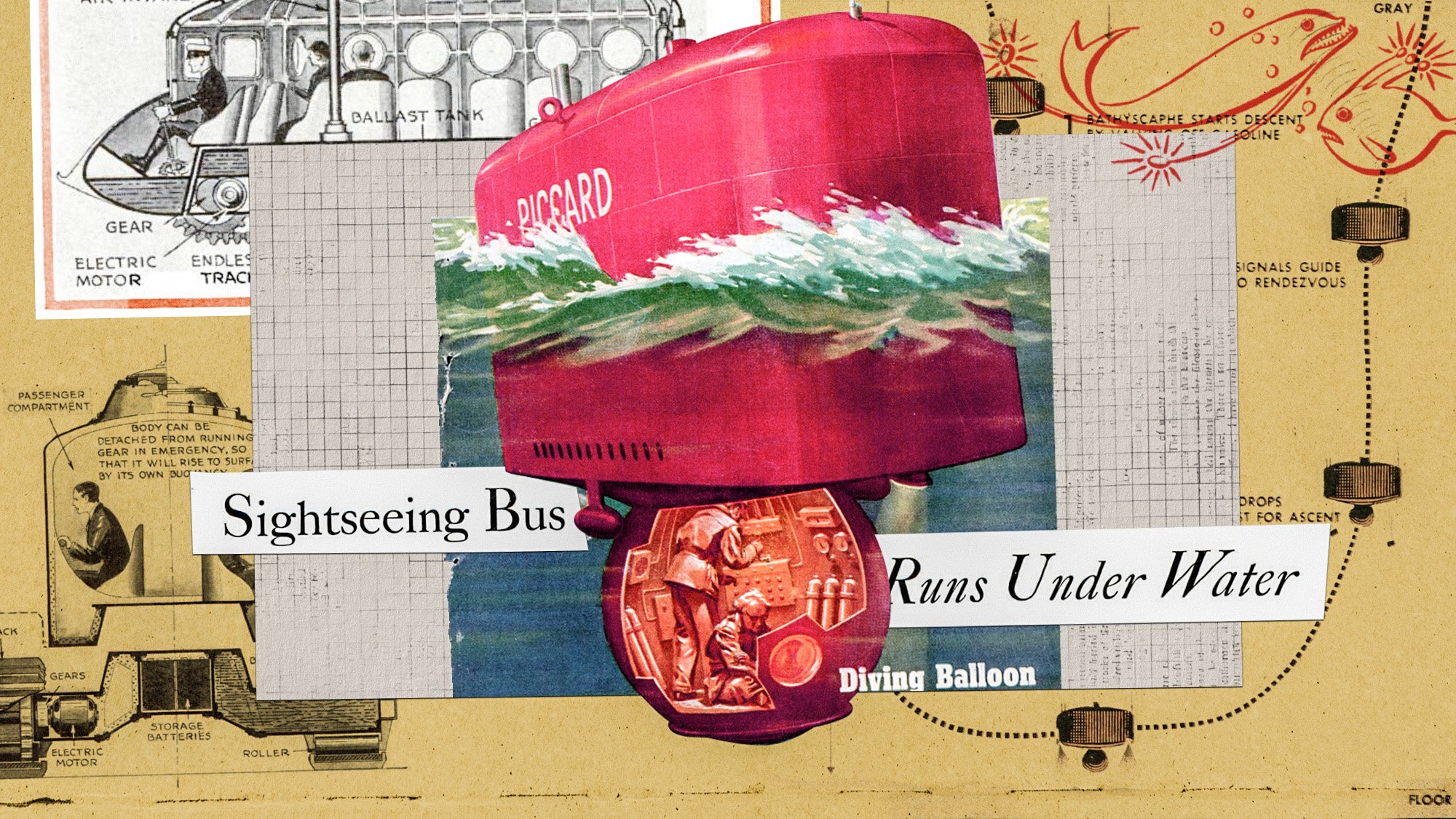
In June 1932, Popular Science described a French engineer’s bold proposal envisioning an “electric submarine automobile”—an invention that captured the global zeitgeist, melding cars with subs. Passengers would descend through a hatchway into a sealed cabin mounted on tractor treads, then crawl along the seafloor peering through portholes, watching marine life glide by.
“The inventor is primarily interested in the possibilities of his vehicle as an amusement device,” wrote Popular Science, “and foresees ‘submarine sightseeing buses’” operating beneath the world’s great beach resorts.
Buried in the unnamed Frenchman’s proposal, Popular Science described a second more ambitious concept: “a submarine railroad in which a passenger car on flanged wheels [like railroad cars] would be pulled along a track laid under the sea.” As early as the 1930s, inventors were beginning to propose fixed infrastructure that could support human habitats under the sea.
How space exploration helped ocean exploration
By the middle of the 20th century, Swiss inventor and explorer Auguste Piccard proved that the technology used to explore space could also be used to access the deepest ocean recesses. In 1931, he ascended into the stratosphere in a pressurized balloon gondola of his own design. In a 1947 feature, Popular Science explained how Piccard had applied the same principle in reverse, attaching a steel sphere to “buoyancy tanks” filled with gasoline, lighter than water just as hydrogen is lighter than air. He called it a bathyscaphe, or “ship of the deep.”
In 1960, his son Jacques and U.S. Navy Lieutenant Don Walsh rode a Piccard-designed bathyscaphe, the Trieste, nearly seven miles down to the farthest reaches of the ocean (or “inner space,” a term some explorers adopt to contrast to outer space). The pair went all the way down to a 43-mile-wide and 1,500-mile-long depression in the Pacific Ocean’s Mariana Trench, known as the Challenger Deep.
The tourism tide rushes in
A year earlier, in 1959, Walt Disney opened the Submarine Voyage at Disneyland. On the ride, vessels named Nautilus and Skipjack, visited a recreation of the lost city of Atlantis. The subs never actually submerged—passengers simply sat below the lagoon’s waterline—but the ride embodied a growing appetite for underwater tourism.
At Switzerland’s 1964 national exposition in Lausanne, Jacques Piccard launched the mésoscaphe Auguste Piccard, named for his father, who had died two years earlier, into Lake Geneva. With a capacity of 45 passengers, the mésoscaphe, a submarine for shallow to mid-range depths, made more than a thousand dives that summer, ferrying 33,000 ordinary people into the lake’s depths.
While Piccard’s mésoscaphe and Disney’s theme park ride encouraged underwater tourism, Edwin Link was busy working out what it would take to inhabit the ocean. In 1962, off the coast of France, Link lowered diver Robert Sténuit in an inflatable chamber of his own design and kept him at 200 feet for more than 24 hours. It was the first sustained test of what would become saturation diving. The technique lets a diver’s body fully adjust to pressure so they can stay at depth for days or weeks, decompressing only once at the end.
Of astronauts and aquanauts
That same year, ocean explorer Jacques-Yves Cousteau used saturation diving to launch his Continental Shelf Station experiments, or Conshelf, off Marseille, France, in the Mediterranean Sea. Conshelf I was an underwater habitat in which two aquanauts lived 33 feet down for a week. The next year, in Conshelf II, aquanauts spent a month at 36 feet in the Red Sea. And in 1965, Conshelf III aquanauts spent three weeks at 325 feet, near Nice, France, in the Mediterranean. The world’s most famous oceanographer was proving, methodically, that the seafloor could be inhabited.
American writer Gardner Soule chronicled the decade’s thrilling race to inhabit the sea in a series of 1960s features for Popular Science. According to Soule, Sealab was the U.S. Navy’s response to Cousteau’s Conshelf experiments. In 1965, Sealab II placed three teams of 10 men at 205 feet off La Jolla, California, for 15 days each. A fourth crew member joined partway through—NASA astronaut Scott Carpenter, who became the first person to be both an astronaut and aquanaut.
In a 1969 Popular Science feature, science writer Steven Spencer described the Tektite program, an underwater habitat in the U.S. Virgin Islands jointly funded by the Department of the Interior, General Electric, and, notably, NASA.
“For 60 days,” Spencer wrote, “the four ocean scientists of the U.S. Department of the Interior lived and swam on the bottom of Lameshur Bay, off St. John.” Although NASA did not use Tektite to train astronauts, the agency wanted to study how small crews handled long-duration isolation, exactly as it would for future space missions.
Tektite II followed, fielding the first all-female team of aquanauts, led by a young marine biologist named Sylvia Earle. Earle became chief scientist at the National Oceanic and Atmospheric Administration from 1990 until 1992. Throughout her storied career, she was one of the world’s most prominent ocean advocates.
The tide ebbs
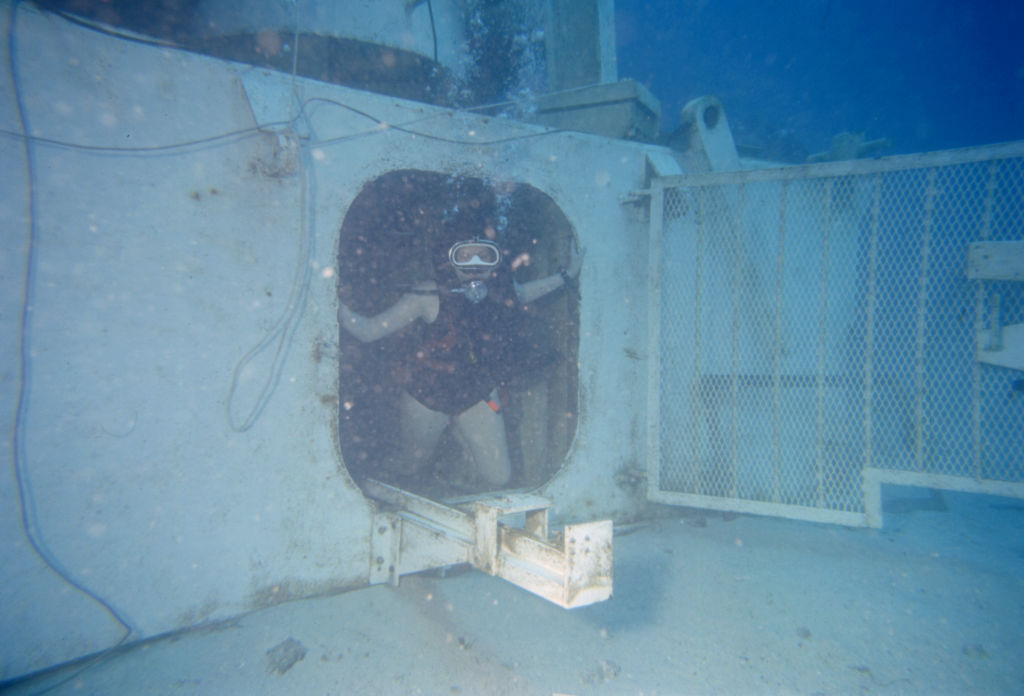
In July 1969, Apollo 11 landed on the Moon. That same year, Sealab III was canceled after diver Berry Cannon died of carbon dioxide poisoning during a botched repair 600 feet down off California. The Navy’s most ambitious underwater habitat was shuttered just as space exploration was reaching new heights.
In 1971, more than half a century after he’d sketched a submarine in his father’s workshop, Edwin Link finally built his very own Nautilus. The Johnson-Sea-Link was a research submersible with a clear acrylic sphere that gave its pilot and observer a panoramic view of the deep.
Two years later, the Johnson-Sea-Link became entangled in cable 360 feet down on a wreck off Key West. Inside its diving chamber were Link’s son Clayton, 31, and Coast Guard officer Albert Stover. For hours, Ed and his wife Marion waited aboard the surface ship as rescue efforts struggled against current and depth to recover them. Both died of carbon dioxide poisoning, the same cause that had ended Sealab III.
Undersea experiments continued, but never again with the same scale and fervor as the 1960s, and with little support from NASA.
But the ocean dream lingered
In 1985, submarine builder Dennis Hurd brought the 1932 engineer’s underwater tourism vision to life when he launched Atlantis Submarines off Grand Cayman, the largest of the Cayman Islands. With operations across the Caribbean and Hawaii, it is the largest and longest-running operator of tourist submarines.
A year later, a repurposed research habitat opened as the world’s first underwater hotel in a Key Largo lagoon: Jules’ Undersea Lodge was named for the novelist who had imagined the whole idea a century earlier. Still operating today, guests scuba-dive 21 feet down to check into a suite that sleeps six.
In the nearby Florida Keys National Marine Sanctuary, NASA resurrected its underwater program in 2001 to capitalize on the strong connections between ocean and space exploration. In a program called NEEMO, astronauts are sent to live for weeks at a stretch in Aquarius, an underwater habitat, where they train for the isolation and spacewalks of future missions.
In 2007, Popular Science profiled submarine designer Bruce Jones’s plan for his Poseidon Undersea Resort, a 40-foot-deep complex of individual suites, with a library, wedding chapel, and restaurant. The hardest part of building the hotel, Jones admitted, would be the acrylic—curved and clear windows for panoramic views, four inches thick, and strong enough to hold back the sea. Nearly two decades later, Poseidon is still seeking investors.
In 2018, Jules’ Undersea Lodge got its first counterpart in the Maldives. The Muraka offers a single hotel suite with living quarters on the surface and a bedroom 16 feet below the waves. The bedroom maintains one atmosphere of pressure, equivalent to sea level, behind walls of seven-inch acrylic. An overnight stay requires no scuba and no decompression, just a staircase down into the reef—and $50,000.
A missed opportunity
In recent decades, enthusiasts, not nations, have funded most exploration of the planet’s deepest places. In 2012, 52 years after Piccard and Walsh descended to Challenger Deep, filmmaker James Cameron became the next person to reach it. Cameron’s 2012 solo dive cost him approximately $8 million—roughly a third of NOAA’s entire annual ocean exploration budget that year. Several years later, private equity investor Victor Vescovo followed.
Besides deep-pocketed enthusiasts, much of today’s renewed interest in the ocean is commercial as much as scientific. The International Seabed Authority has issued 30 prospective mining contracts to 21 companies from 20 countries to explore the seabed for cobalt, manganese, and other critical minerals.
In 2013, NASA’s space exploration budget outspent NOAA’s ocean exploration program by more than 150 to 1 ($3.8 billion versus $23.7 million). A decade later, as both budgets grew, so did the gap, now about 175 to 1.
If America—if the world—had invested in ocean exploration even a fraction more, we might now be vacationing on the seafloor. We might also understand, far better than we do, how the ocean we’d be vacationing in keeps our climate so hospitable.
Even after losing his son to the sea, Edwin Link continued work on the ocean frontier until his death in 1981. The boy who drew a submarine in his father’s workshop, and the man who spent decades proving the ocean could be lived in, would marvel at how far we’ve come—and wonder why we’ve settled for so little.
In A Century in Motion, Popular Science revisits fascinating transportation stories from our archives, from hybrid cars to moving sidewalks, and explores how these inventions are re-emerging today in surprising ways.
Related ‘Century in Motion’ Stories
In 1934, Chrysler bet big on teardrop-shaped cars
In 1871, cities almost got moving sidewalks. Why are we still waiting?
During WWI, a daredevil pilot helped invent the first ‘drones’
In 1916, hybrid cars could’ve changed history. But Ford wouldn’t allow it.
A century ago, suspended monorails were serious mass-transit contenders
The post Before the moon race, explorers wanted to conquer the ocean appeared first on Popular Science.